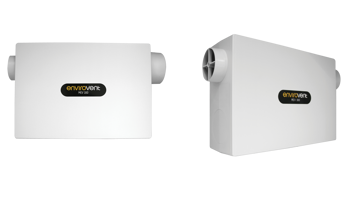
Centralised Mechanical Extract Ventilation (MEV)
Mechanical Extract Ventilation (MEV) systems use a centralised unit to continuously remove stale, moist air from multiple wet rooms within a property.
Ventilation type
No results found.

Centralised Mechanical Extract Ventilation (MEV)
Mechanical Extract Ventilation (MEV) units are centralised systems that continuously remove stale, moist air from multiple wet rooms within a property. They are typically installed within a loft space or central cupboard. Some units are only suitable for a fixed number of wet rooms, whereas other units offer the ability to increase or decrease this using caps and additional spigot packs, providing a more modular solution.
Centralised MEV units are often installed with either semi-rigid ducting, such as the Fast Track ranges, or with rigid PVC ducting. These units often include boost switches, a humidity sensor and can offer a 0-10V port for external controllability. c-MEV does require a ducting layout, and this should be factored in at the earliest opportunity, with appropriate plans and drawings provided to create a suitable design for compliant airflow rates across the property. There is a small amount of background ventilation required, totalling 4000mm² per habitable room, to cover the areas not directly ventilated by the unit.
Centralised Mechanical Extract Ventilation (MEV)
Frequently Asked Questions
Mechanical Extract Ventilation. This is also known as c-MEV, which is a centralised ventilation unit, often located in a loft space, cupboard or void, that extracts stale, moist air from the wet rooms in a property (kitchen, bathroom, utility and WC) out to atmosphere. These units have several lengths of ducting that each run into a wet room before being extracted to the central unit, with a single ducting point out to atmosphere.
Mechanical Extract Ventilation fans are designed to run continuously at a low or background rate. The units will then boost when required; sometimes this may be via a humidity or usage sensor, or through a scheduling feature. Some units may also have a third speed. Both the boost and third speeds are temporary and designed to remove stale air. They can also be used for other reasons, including increased occupancy and overheating. MEV units are set up based upon the property's airflow calculations, which often involves a system design, according to which the unit is then set up and commissioned.
Mechanical Extract Ventilation (sometimes written as c-MEV) is a single centralised unit in a space such as a loft or storage area. This unit is then ducted into each wet room, with a single point of extraction from the unit to atmosphere. d-MEV involves the use of single de-centralised units in each wet room, which are either ducted or installed out to atmosphere.
Some Mechanical Extract Ventilation units come with humidity or usage sensors to vary the speed of the units and to programme their usage. Depending upon the size and type of the MEV unit, some may ventilate a fixed number of rooms, while others, such as the MEV 300, may ventilate three wet rooms but with the potential to add more rooms.
Mechanical Extract Ventilation systems extract air from wet rooms out to atmosphere, either by a centrally mounted system (MEV) or single de-centralised units (d-MEV), with no air being supplied in from atmosphere. The MVHR units both extract stale, moist, warm air from the wet rooms and supply fresh, filtered air into the property, while the inclusion of the heat cell allows for recovery of the heat. MVHR units also offer many smart features, such as the use of CO₂, humidity and usage sensors, app controllability and multiple speed controls.
There is a small amount of background ventilation required when using Mechanical Extract Ventilation units, which is to have 4,000mm² in each habitable room (living, bedroom or study areas) to cover areas not ventilated by the MEV system, and provide adequate crossflow of air into the property. A typical single trickle vent found above a window is 2,500mm², so either two of these or potentially a single larger option would be acceptable.
MEV ventilation systems are suitable for properties with any level of air tightness. However, this involves a significant amount of planning for ducting routes between the wet rooms, which need to be run through voids and other spaces. For retrofit properties, this should be factored in at the earliest opportunity due to the works involved.