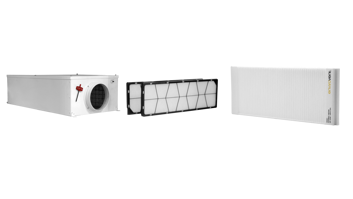
Ventilation Filters
Ventilation filters help to reduce airborne contaminants entering a property and support overall indoor air quality.
Ventilation type
No results found.

Filters
There are several filters available depending upon the type of ventilation unit, with some included as standard and no requirement in other units. These used to be graded as per EN 779 as G4, F7, M6 or similar, depending upon the grading and particle size. In 2018, this was changed under ISO 16890, and filters are now often seen with classifications like Coarse 65% or ePM10 50%, which determines the type of filter and the size of particles that can pass through the filter itself.
There are some specialist filters available, such as higher-grade finer filters for pollen or allergens, carbon filters for use in cooker hoods or for reduction in odours, and those for coarse materials like sand. Ventilation filters are generally used to help with the supply of air into a property, but some are also offered on extract fans or in specific scenarios. These filters should be periodically checked, cleaned and replaced. The frequency depends upon the location of the property, the grade of the filter and how the unit is being run.
Ventilation Filters
Frequently Asked Questions
Filters are used to reduce the potential of airborne contaminants often found in household carpets, air fresheners, mould, pollen and dust from entering a property. Some ventilation units have filters as standard, particularly those that are supplying air into a property. Filters are graded depending on the amount and size of particles that they can allow through. This is usually defined with percentages and figures that relate to the size of the particles. Most ventilation units at envirovent that have a filter included have either ISO Coarse 45% or 65% filters as standard. Further information can be found on envirovent's website regarding grading.
All PIV units including ATMOS and ATMOS Wall, MVHR units including the Nitrobox, the Eco dMEV+ and Eco dMEV+LC fans offer a variety of filters up to F7 or ePM1 70% grades, helping to reduce these contaminants entering the home. Filter boxes are also available that can be added onto some units including the Inline fan range.
Several grades and types of ventilation filters are available, including pleated filters, wrap-around or plastic-framed filters. The size and type of these vary depending on the type of unit and grading. Typically, ISO Coarse 45%, 60%, 65%, ePM10 50%, ePM1 2.5%, ePM1 70% and carbon filters are offered, giving a real variety to ensure peace of mind about the breathability in properties.
Filters should be checked and changed regularly. There are no specifically defined timeframes as it depends upon the type of unit, grade of filter and surrounding area. A carbon filter or highly rated filter will need to be checked, cleaned and checked a lot more than a lower-rated filter. A similar filter within a property in a city centre would need to be replaced at a different frequency compare to one in a property in the countryside. For further details on ventilation filter inspection and replacement please contact us.
Filters do come in different sizes and thicknesses, generally based on the size of the ventilation unit. They also vary based on their grade and type, such as pleated and fabric filters, which look and feel very different.
Some ventilation units have specific filter slots, others require the lifting of a cover or lid to replace, and others have a Velcro outer for easy replacement. Details on how to fit a replacement filter can be found in the installation guide and user resident guide of the ventilation unit, or can be carried out as part of a service by envirovent. Contact us for more information.
Replacement filters designed for the specific ventilation units that envirovent offers can be purchased via specialist stockists. Please contact us for further information.