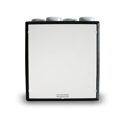
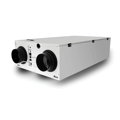
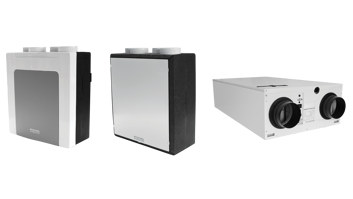
energiSava® 260
The energiSava® 260 is a mechanical ventilation with heat recovery unit incorporating an EC motor, providing optimum ventilation for a property with a minimum loss of energy.
Mechanical Ventilation with Heat Recovery (MVHR) systems provide balanced ventilation by extracting stale, moist air from multiple wet rooms and supplying fresh, filtered air throughout a property.
The energiSava® 260 is a mechanical ventilation with heat recovery unit incorporating an EC motor, providing optimum ventilation for a property with a minimum loss of energy.
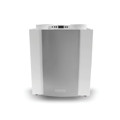
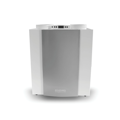
The energiSava® 200, a mechanical ventilation with heat recovery unit, incorporates a powerful backward curved EC motor, mechanical summer bypass and delivers exceptional performance within a compact unit.
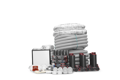
The envirovent kit is the most complete MVHR system on the market it includes everything you will need to install the system right down to the screws and sealant. The kit is suitable for properties with up to 3 bedrooms and that have a floor area below 130m².
The energiSava® 300, a mechanical ventilation with heat recovery unit, is ideal for residential properties to provide a constant supply of tempered air and maintain stable humidity levels. With maximum airflow capacities of 300 m3/h respectively, the unit is available in left-handed and right-handed versions with a range of options for connecting the ducts.
The energiSava® 400, a mechanical ventilation with heat recovery unit, is ideal for residential properties to provide a constant supply of tempered air and maintain stable humidity levels. With maximum airflow capacities of 400 m3/h respectively, the unit is available in left-handed and right-handed versions with a range of options for connecting the ducts.
The SABIK 350, a mechanical ventilation with heat recovery unit, has been designed to provide balanced and sustainable ventilation whilst incorporating modular features and user friendly controllability resulting in a highly efficient, market leading ventilation system.
The SABIK 500, a mechanical ventilation with heat recovery unit, has been designed to provide balanced and sustainable ventilation whilst incorporating modular features and user friendly controllability resulting in a highly efficient, market leading ventilation system.
The high-efficiency SLIMLINE 150, a mechanical ventilation with heat recovery unit, is ideal for ceiling mounted applications such as apartments, properties with a lack of storage space, and student accommodation to provide optimum ventilation.
The high-efficiency SLIMLINE 300, a mechanical ventilation with heat recovery unit, is ideal for ceiling mounted applications such as apartments, properties with a lack of storage space, and student accommodation to provide optimum ventilation

MVHR is a whole-house ventilation system that both supplies fresh, filtered air and extracts stale, moist air from a property, with the added benefit of heat recovery from the internal heat cell. This negates the need for any additional background ventilation, such as trickle or through-wall vents, making it a good choice where either this is not preferred or there is a restriction in place.
MVHR is also a preferred option if there is an acoustic, overheating or pollution concern at the property that prevents the opening of windows, and is typically offered using a variety of ducting, such as Fast Track thermal, semi-rigid and rigid PVC. MVHR units are typically mounted in a centralised store or plant room and require a full ducting layout that should be factored in at the earliest opportunity, with appropriate plans and drawings provided to create a design and airflow rates for compliance across the property. MVHR is also a requirement for Passivhaus compliance.
Frequently Asked Questions
Mechanical Ventilation with Heat Recovery. An MVHR system extracts air from wet rooms such as kitchens, bathrooms and utility rooms. The heat that is taken through this extraction is retained in a cell centrally within the unit, whilst the stale, moist air is expelled out to atmosphere. Simultaneously, the unit also supplies fresh, filtered air in from atmosphere, which enters the cell and transfers that retained heat back into the property. This can help to reduce heating costs and provide effective, balanced ventilation.
MVHR systems are designed to run continuously at a low or background rate. The units will then boost when required, which may be via a humidity or usage sensor, or through a scheduling feature. Some units may also have a third speed. Both the boost and third speeds are temporary and are designed to remove stale air, or can be used for other reasons, including increased occupancy and overheating. MVHR units are set up based on the airflow calculations of the property, which often involve a system design, according to which the unit is then set up and commissioned.
As the MVHR unit both extracts stale air and supplies fresh, filtered air into the property, there is no background ventilation required.
The vast majority of MVHR systems are installed as a whole-house solution to ensure balanced airflows. However, there are single-room heat recovery fans (sometimes known as SRHR or d-MVHR) available for remote or single areas, such as our heatSava. It is important to ensure that the airflows in the units are balanced; otherwise, this could lead to localised mould and issues with poor ventilation.
Some MVHR units have a pre-heater, either installed as standard or as a modular option, with other units also offering post-heaters. However, these are not designed for heating the property and are instead designed to temper the air entering the property for comfort.
Although MVHR units recover heat that is extracted and, in turn, supply this back into the property, they also have a summer bypass that ensures that this air is diverted around the heat cell in periods of hot weather.
Depending upon the features of the MVHR system, some units have an airflow imbalance, in which the supply side of the MVHR is stopped to prevent the internal workings of the unit, and for comfort reasons. Other MVHR units, including those used in properties built to the Passivhaus standard, and for those properties in which there is a solid fuel appliance, such as a log burner, there will be either an integral or modular pre-heater within the MVHR that will both protect the heat cell and continue to allow the unit to operate as normal.
Mechanical Ventilation with Heat Recovery can be used in any property, regardless of air-tightness levels. However, this involves a significant amount of prior planning for ducting routes, location of units and other considerations. So, if MVHR is being considered for retrofit works, then it will need to be factored in at the earliest opportunity. Different units are available for houses that can be located in areas like plant rooms or storage areas, whereas there are units for apartments that are suitable for installation in a ceiling void.
Mechanical Ventilation with Heat Recovery is often recommended for new-build properties or during a building process, due to the ease of being able to run ducting lengths. However, with care and appropriate planning, MVHR can be retrofitted into existing buildings. It is also commonly used in periods in which there is an acoustic, pollution or overheating concern, such as in proximity to an airport, motorway, basement apartment or location in which there are fixed windows that are unable to be opened.
MEV extracts air from wet rooms out to atmosphere, either by a centrally mounted system (MEV) or single, decentralised units (d-MEV), with no air being supplied in from atmosphere. MVHR systems both extract the stale, moist, warm air from the wet rooms and supply fresh, filtered air into the property, as well as the inclusion of the heat cell providing the heat recovery. MVHR units also offer many smart features, such as the use of CO₂, NO₂ humidity and usage sensors, app controllability and multiple speed controls.