

What the course offers
The NICEIC domestic ventilation training and assessment course has been developed by leading industry experts and focuses on providing a technical competency for electricians, contractors, heating engineers and ventilation installers. The course covers everything from natural ventilation to commissioning of a mechanical ventilation heat recovery unit. On successful completion, you will receive an NICEIC certificate.
What is covered on the domestic ventilation course?
The course has been designed to improve your knowledge of domestic ventilation systems and have a good understanding of how they work. This is the minimum technical competency requirement for installers looking to apply to join a Competent Person Scheme in England, Scotland, Wales and Northern Ireland.
The domestic ventilation training and assessment course has been designed to provide you with the required skills in the principles of ventilation, design, installation, testing, commissioning, handover, servicing and fault-finding of domestic ventilation systems in accordance with the National Occupational Standards and Minimum Technical Competency documents.
Do I need to have knowledge of ventilation systems already?
It is advised that candidates are competent and have some knowledge of domestic ventilation systems prior to attending. We also suggest experience within the heating, plumbing or electrical sector to complete the assessment at the end of the course. Although there is no direct requirement for attending the course.
What does the course involve?
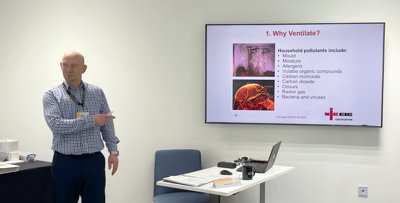
The training course is split over two days, the first day will cover the fundamental principles of ventilation systems and a detailed overview of the different ventilation systems available and then the second day will involve a practical and assessment of a domestic ventilation system. Full details of what is included are shown below:
Day 1
Fundamental working principles of ventilation systems
Minimum legal requirements
The types of ventilation systems
Intermittent Extractor Fans
Continuous Mechanical Extract Systems
Mechanical Ventilation with Heat Recovery (MVHR)
Why ventilation is important
The varying techniques used for installation of the different systems
The pitfalls associated with poor workmanship and misuse of ventilation systems
Preparation prior to installation
Day 2
Competent Person Scheme
Commissioning of a mechanical ventilation heat recovery unit
Inspection and testing
Certification and documentation of a mechanical ventilation heat recovery unit
Assessments
How can I book onto a NICEIC training course?
envirovent have an NICEIC Approved Training Centre which has been designed and fitted with ventilation units to carry out domestic ventilation training and assessment courses. All our domestic ventilation training courses are carried out over two days and take place in our purpose-built training centre in Harrogate. You can reserve your place on one of the courses today by emailing niceic@envirovent.com or by clicking the link to our booking platform https://bookwhen.com/enviroventniceic
How much does the course cost?
The price of the course is £250 +VAT. Costs include refreshments, lunch, free onsite parking and a certificate from NICEIC on successful completion of the course.
One of the main benefits of manufacturer-led ventilation training is the significant improvement in technical proficiency and problem-solving abilities that installers can expect to gain.
Why it matters
Larry Soper, Technical Services Manager at envirovent, looks at the importance of professional ventilation training for installers and engineers.
The 2021 ventilation updates to Building Regulations affecting both new and existing homes, combined with greater awareness of the importance of indoor air quality mean that demand for professional ventilation services continues to rise.
There are a wide variety of benefits that accredited manufacturer-led training programmes offer to ventilation professionals, from enhancing an installer’s technical expertise to opening new business opportunities.
Since 2021, installation of most ventilation systems became notifiable work as a result of changes to Building Regulations Approved Document F. These changes required that systems be fitted by competent and qualified individuals, which over the years has led to a marked increase in the number of installers seeking certification in domestic ventilation.
Whole-house ventilation
The tightened Building Regulations have also meant that continuous running ventilation strategies are often the best way to meet requirements both in new build homes and refurbishments. Most of these strategies require setting up, commissioning and, in many cases, a series of duct runs around the dwelling, requiring careful consideration o the layout, connections and calculations.
In addition, with a greater focus on reducing carbon footprints and improving energy efficiency in buildings, ventilation systems play a crucial role. Modern ventilation systems are designed to maintain good indoor air quality while minimising heat loss, a balance that requires skilled installation to achieve optimal performance.
The NICEIC Certification
The National Inspection Council for Electrical Installation Contracting (NICEIC) is a recognised certification for Domestic ventilation installers, is offered by some manufacturers and also through training providers. This certification has become a benchmark for installers wanting to join a competent persons’ scheme for ventilation.
NICEIC certification is widely recognised within the construction and property sectors. It provides installers with a basic understanding of the different ventilation strategies as well as the installation and commissioning of these systems.
The NICEIC Domestic Ventilation course is typically a two-day programme that covers a comprehensive range of topics. Day one focuses on the fundamental principles of ventilation systems, legal requirements, plus an overview of different system types. The second day involves practical assessments and examinations to test the installer's knowledge and skills.
Candidates are evaluated through a combination of written examinations and practical assessments. Successful completion of the course results in a certification that is valid for five years, after which installers can renew their qualification to ensure their knowledge remains current. The certification allows an installer to register with a 3rd party competent person scheme, such as those available through NICEIC, NAPIT or Elmhurst.
Self-Certification
One of the key benefits of 3rd party competent persons schemes is the ability for installers to self-certify their work in homes in England and Wales. This can streamline the installation process and provide added value to clients by reducing the need for additional inspections.
Many manufacturers, including envirovent, can offer further training such as CPD’s and toolbox talks to further enhance knowledge.
A significant part of the training is dedicated to understanding Building Regulations relating to ventilation installation. This knowledge is essential for installers to ensure their work meets all necessary regulations and can be certified accordingly.
Completing a manufacturer's training course also comes with the added benefit of ongoing technical support. This can be invaluable when installers encounter complex installation or require assistance with troubleshooting.
Practical combined with theoretical
Practical training forms a core component of manufacturer-led ventilation courses. Installers gain experience with different types of ventilation systems, learning effective installation techniques and how to avoid common pitfalls.
An essential skill for any ventilation installer is the ability to test and commission systems once installed. Training courses cover the procedures for ensuring systems are functioning correctly and efficiently.
To provide a comprehensive service, installers must be able to maintain systems and diagnose issues.
One of the main benefits of manufacturer-led ventilation training is the significant improvement in technical proficiency and problem-solving abilities that installers can expect to gain.
As demand for professional ventilation services continues to grow, installers can ensure they remain at the forefront of technological advancements and product innovation through manufacturer-led training courses.
Investing in accredited ventilation training can have a very positive impact on an installer's business prospects too. The enhanced skills and certifications mean installers can broaden their service to include a wider range of ventilation solutions, attracting a larger customer base.
Final thoughts
There are many reasons for installers to undertake manufacturer-led NICEIC ventilation training, whatever stage of their career they are at.
For those considering their first role in ventilation installation or looking to enhance their existing skills, investing in accredited manufacturer-led training programmes can make a huge difference.
Looking to the future with the introduction of the Future Homes Standard and greater emphasis being placed on low carbon installations, the role of skilled ventilation installers becomes even more crucial.
envirovent has a dedicated training facility at its headquarters in Harrogate, offering accredited NICEIC Domestic Ventilation courses throughout the year. The company also offers Toolbox talks and a RIBA/CIBSE accredited CPD: Ventilation Strategies and Best Practice Compliance. envirovent also offers a CPD accredited Condensation and Mould workshop designed for social housing providers. The company has dedicated training and technical teams, able to advise on Building Regulations and compliance and to provide product training and support.
For more information about envirovent visit www.envirovent.com or call 01423 810 810.
For those considering their first role in ventilation installation or looking to enhance their existing skills, investing in accredited manufacturer-led training programmes can make a huge difference.
NICEIC Training
Frequently Asked Questions
There are no pre-requisites to attend the training, knowledge or experience within the industry will be beneficial but not required.
The course cost and availability can be found within the link on the website or further information can be obtained by emailing niceic@envirovent.com
Need help or have a question? Contact our friendly team today!
Contact UsOur Accreditations
We're proud to hold certifications from leading industry bodies, demonstrating our commitment to quality and compliance

BBA Accreditation
Passive House Institute

Passivhaus Trust

CIBSE Patrons
CIBSE CPD
RIBA CPD
Saint Michael's Guild of Patrons
ISO 9001
ISO 14001
Exor Gold Accreditation
NICEIC Approved Centre
NICEIC Approved Contractor
BESA - Building Engineering Services Association

TRUSTMARK - Government Endorsed Quality
EDA - Electrical Distributors Association
SAFEMARK - Health and Safety Approved by NHBC
Contractors Health and Safety Assessment Scheme (CHAS)

PCA - Property Care Association
Electrical Contractors' Association
National Home Improvement Council
The Radon Council
